Sometimes I have to put text on a path

Saturday, May 19, 2012

list of software (molecular graphics,molecular mechanics modeling,quantum chemistry), van der waals radius; and many water effects

molecules and  chromophores, dyes, absorbers, absorption spectrum (macroscopic) and nanoworld...

Basics:

List of molecular graphics:
http://en.wikipedia.org/wiki/List_of_molecular_graphics_systems
http://en.wikipedia.org/wiki/Molecular_graphics
http://en.wikipedia.org/wiki/List_of_web_resources_for_visualizing_molecular_dynamics
http://en.wikipedia.org/wiki/Molecular_design_software
http://en.wikipedia.org/wiki/Molecule_editor

http://en.wikipedia.org/wiki/List_of_software_for_nanostructures_modeling

List of software for molecular mechanics modeling:
http://en.wikipedia.org/wiki/List_of_software_for_molecular_mechanics_modeling

List of quantum chemistry and solid-state physics software:
http://en.wikipedia.org/wiki/List_of_quantum_chemistry_and_solid_state_physics_software

GPU accelerated molecular modelling software:
http://en.wikipedia.org/wiki/Molecular_modeling_on_GPUs
http://www.nvidia.com/object/molecular_dynamics.html
http://dx.doi.org/10.1016/j.jmgm.2010.06.010

Interoperability:

OpenBabel: http://openbabel.sourceforge.net
JOELib — Java version of OpenBabel/OELib

Structure download:
example: http://www.chemicalbook.com/ChemicalProductProperty_EN_CB2121273.htm
lucifer yellow:
http://pubchem.ncbi.nlm.nih.gov/summary/summary.cgi?cid=12087397

Electron Density Server:
http://eds.bmc.uu.se/eds/
"ex-ample": deoxyhemoglobin: http://eds.bmc.uu.se/cgi-bin/eds/uusfs?pdbCode=1a3n

MolviZ.Org: Molecular Visualization Resources with rich collection of molecules:
http://www.umass.edu/microbio/chime/
Hemoglobin: http://www.umass.edu/molvis/tutorials/hemoglobin/
VERY GOOD
http://biomodel.uah.es/en/water/index.htm
http://www.messiah.edu/departments/chemistry/molscilab/Jmol/collagen/collagen_index.htm

Molecule editor;
Free Standalone programs (multiplatform & MacOSX), just "small programs for dummies":
1/ http://avogadro.openmolecules.net/wiki/Main_Page
2/ MacMolPlt : A modern graphics program for plotting 3-D molecular structures and normal modes (vibrations): http://www.scl.ameslab.gov/MacMolPlt/
3/Ball view (MACOSX Darwin: auto with CPack (http://www.cmake.org)): http://en.wikipedia.org/wiki/BALLView
4/ Crystallographic Object-Oriented Toolkit: Coot: http://lmb.bioch.ox.ac.uk/coot/ near of Alwyn Jones' O, Quanta, XtalView, CCP4mg
5/CueMol2 aims to visualize the crystallographic models of macromolecules. Currently supported files are molecular coordinates (PDB format), electron density (CCP4, CNS , and BRIX formats), MSMS surface data, and APBS electrostatic potential map. Powered by Mozilla XULRunner, the application framework of Firefox and Thunderbird (and other mozilla-based application as well). http://www.cuemol.org/en/index.php?Download
6/Gabedit (release:October, 2009) is a Graphical User Interface to GAMESS (US) , GAUSSIAN, MOLCAS, MOLPRO, MPQC, OpenMopac, PC GAMESS, Orca and Q-Chem computational chemistry packages. http://gabedit.sourceforge.net/
7/Molden (dec 2010): http://www.cmbi.ru.nl/molden/molden.html
8/PyMol: http://en.wikipedia.org/wiki/PyMOL; http://pymol.org/
9/RasMol: http://en.wikipedia.org/wiki/RasMol;
10/SPARTAN (demo):  http://en.wikipedia.org/wiki/Spartan_(software); Molecular mechanics calculations and quantum chemical calculations; spectral properties; VERY GOOD.
11/VMD http://en.wikipedia.org/wiki/Visual_Molecular_Dynamics; http://www.nvidia.com/object/molecular_dynamics.html; http://www.ks.uiuc.edu/Research/vmd/
12/yasara:  http://www.yasara.org/viewdl/; http://swift.cmbi.ru.nl/teach/
13/http://en.wikipedia.org/wiki/WHAT_IF_software; correction of pdb file.

Online editors/viewers with many one-click web services:
2D: in pure Javascript, http://pubchem.ncbi.nlm.nih.gov/edit/index.html
3D: http://pubchem.ncbi.nlm.nih.gov/release3d.html
example: http://pubchem.ncbi.nlm.nih.gov/vw3d/vw3d.cgi?cmd=crtvw&reqid=2150958658207150582
Ref: http://www.ncbi.nlm.nih.gov/pubmed/21933373 J Cheminform. 2011 Sep 20;3(1):32. PubChem3D: a new resource for scientists.
http://www.ncbi.nlm.nih.gov/Structure/index.shtml
or stand alone PubChem 3D Viewer : http://pubchem.ncbi.nlm.nih.gov/pc3d/

Web-based systems are based on 3 strategies
( http://ex-ample.blogspot.fr/2012/05/web-viewers-molecular-visualization-off.html)
  1. VRML
  2. java (JMol needs java machine).
  3. WebGL : Javascript, HTML5. It doesn't need Java or plugins. 
http://en.wikipedia.org/wiki/WebGL
WebGL (Web Graphics Library) is a JavaScript API for rendering interactive 3D graphics within any compatible web browser. WebGL programs consist of control code written in JavaScript and shader code that is executed on a computer's Graphics Processing Unit (GPU). Notable early applications of WebGL include Google Maps and Google Body or Zygote Body. On October 13, 2011 the Google Body site was shut down. Then on January 9, 2012 Zygote Body was launched and core code base (with the Google Cow model as a demo) was made available as an open source project called: http://code.google.com/p/open-3d-viewer/
http://learningwebgl.com/blog/
http://www.webgl.com/

GLmol is a molecular viewer for Web browsers written in WebGL/Javascript. Like Jmol, but MUCH faster, GLmol is a 3D molecular viewer based on WebGL and Javascript.
http://www.webgl.com/2012/03/webgl-demo-glmol-molecular-viewer/
http://webglmol.sourceforge.jp/index-en.html

Surface calculation and visualization (in development; available in special version):
  • van der Waals surface
  • Molecular surface
  • Solvent accessible surface
  • Solvent excluded surface
http://webglmol.sourceforge.jp/surface.html
Surface representation is a convenient way to visualize protein-protein and protein-ligand interactions. However, surface calculation of macromolecules is computationally and memory intensive. Furthermore, calculated mesh is very complex, often exceeding 500000 polygons. Therefore its implementation in Javascript/WebGL was considered to be very difficult.
 EDTSurf algorithm published by Dong Xu and Yang Zhang in 2009 (EDTSurf: Quick and accurate construction of macromolecular surfaces; D. Xu, Y. Zhang (2009) Generating Triangulated Macromolecular Surfaces by Euclidean Distance Transform. PLoS ONE 4(12): e8140) is very efficient and runs with practical speed (even after I ported it to Javascript). I integrated it with GLmol, my WebGL-based molecular viewer, and release it here. 
Example: Solvent excluded surface of horse deoxyhaemoglobin (PDBID: 2DHB)
Computation time and Memory usage
In modern computers with Intel Core i5/i7 processor, grid size up to 180x180x180 can be calculated in acceptable time (5-10sec). Although Firefox 8 was about 3 times slower than Chrome, with Firefox 9, the difference is getting smaller. Current problem is its memory usage. It uses about 500MB RAM for computation. The original version written in C++ doesn't use so much memory. Now I am working to reduce memory usage in my Javascript version. Basically, if GLmol runs on your PC, this demo should work. For better performance, I recommend Google Chrome with sufficient memory (>1GB for browser). You can try alpha version from the following link. Please note that this is ALPHA version and there remains many issues. WARNING! This program consumes lots of memory (500-700MB). Your browser and computer might GET VERY SLOW and EVEN CRASH if memory is insufficient!
Demo version
To limit CPU & memory usage, calculation grid size is restricted to 180x180x180. Therefore, if you calculate a large surface, output quality will be compromised.


To learn how to embed GLmol into your page, please examine source code of :
http://webglmol.sourceforge.jp/glmol/embedding-examplesEN.html        (1)
The following model is horse deoxyhaemoglobin(Adapted from PDB 2DHB).
The Iron atom (colored ocher) is coordinated by five nitrogen atoms (colored blue); four from a heme and one from a histidine residue in the protein. When oxidized, an oxygen molecule binds at the opposite side of the histidine as another axial ligand.
You can embed multiple instances of GLmol in a page. Molecular representations can be customized by Javascript. For the details, please examine the source code of this page (1). If it is not clear, don't hesitate to ask (biochem_fan at users.sourceforge.jp).
http://www.rcsb.org/pdb/explore/explore.do?structureId=2dhb
Three dimensional fourier synthesis of horse deoxyhaemoglobin at 2.8 Angstrom units resolution.Bolton, W.,  Perutz, M.F.,  Journal: (1970) Nature 228: 551-552

WebGL Other libraries:
just for the fun:
http://www.chromeexperiments.com/detail/protein-ribbon-models/?f=
http://www.ichemlabs.com
Technology: WebGL, ChemDoodle Web Components, jQuery, glMatrix, XHR2

SpiderGL
Visualization Methods for Molecular Studies on the Web Platform
http://vcg.isti.cnr.it/Publications/2010/CADZS10/
see also: http://ex-ample.blogspot.fr/2012/05/web-viewers-molecular-visualization-off.html


The ChemDoodle Web Components, which display 3D molecular models and other chemical structures in web pages, have hit version 4.4.0; this new and improvedProtein Data Bank model demo is particularly nice, as is this new demo for crystallography.

Many frameworks:


List of molecular graphics systems with Java applet :
Jmol: Java applet or stand-alone application. It does not require 3D acceleration plugins.
Jmol supports many molecular file formats, including Protein Data Bank (pdb), Crystallographic Information File (cif), MDL Molfile (mol), and Chemical Markup Language (CML).
extension for mediawiki: http://www.mediawiki.org/wiki/Extension:Jmol. The tag can be used to display in 3d a molecule file that has been previously uploaded into Wikipedia. Some examples of its usage are available in the Jmol wiki: http://wiki.jmol.org/index.php/MediaWiki/Basic%20Example
MDL Chime is a free plugin used by web browsers (windows) to display the 3D structures of molecules. It is based on the RasMol code. Stable release: 2.6 SP7 / July 31, 2007; 5 years ago. Chime largely has been superseded by Jmol. A feature of Chime which is not yet reproduced with Jmol is the calculation of electrostatic or hydrophobic potential for use in coloring molecular surfaces. Instead, Jmol relies on this data being provided by other calculation packages.
Molekel: stable 5.4 / August 2009; 2 years ago. 36MB Mac OS X Intel (built on Mac OS X 10.4.11; require X11 due to a dependency in one of the libraries). Complete control over the generation of molecular surfaces (bounding box and resolution); Visualization of the following surfaces: orbitals; Isosurface from electron density data; Isosurface from Gaussian cube grid data;Solvent-accessible surface (SAS); Solvent excluded surface (SES); Van del Waals radii; Animation of molecular surfaces; Animation of vibrational modes;Export animation; Plane widget to visualize a scalar field: the plane can be freely moved in 3d space and the points on the plane surface will be colored according to the value of the scalar field: a cursor can be moved on the plane surface to show the exact value of the field at a specific point in space; Fully Doxygen-commented source code. You can also build:
 http://molekel.cscs.ch/svn/molekel and http://molekel.cscs.ch/wiki/pmwiki.php/Main/Build
http://molekel.cscs.ch/wiki/pmwiki.php

Sirius: http://en.wikipedia.org/wiki/Sirius_visualization_software; Interactive calculation of hydrogen bonding, steric clashes, Ramachandran plots
SRS3D Viewer: http://srs3d.org/
WebMol: http://www.cmpharm.ucsf.edu/cgi-bin/webmol.pl (very old).
Relibase: http://www.ccdc.cam.ac.uk/free_services/relibase_free/
Proteopedia: http://www.proteopedia.org/wiki/index.php/Main_Page; Java applet integrated into web front-end.
Chemistry Development Kit: The CDK was created by Steinbeck, Willighagen and Gezelter, the developers of Jmol and JChemPaint (2D). The CDK itself is a library, instead of a user program. However, it has been integrated into various environments to make its functionality available, the R (programming language),CDK-Taverna (a Taverna workbench plugin), Bioclipse, and Cinfony. Additionally, CDK extensions exist for KNIME and Excel (excel-cdk). Chemoinformatics: substructure search using exact structures and SMARTS-like queries, QSAR descriptor calculation, Kuhn et al (2010). "CDK-Taverna: an open workflow environment for cheminformatics". BMC Bioinformatics 11: 159. doi:10.1186/1471-2105-11-159.

---------------Environment
Extensible Computational Chemistry Environment (ECCE) The Extensible Computational Chemistry Environment provides a sophisticated graphical user interface, scientific visualization tools, and the underlying data management framework enabling scientists to efficiently set up calculations and store, retrieve, and analyze the rapidly growing volumes of data produced by computational chemistry studies.
-importing results from NWChem, GAMESS-UK, AMICA, Gaussian 94, Gaussian 98, and Gaussian 03 calculations
-Remote submission of calculations to UNIX and Linux workstations, Linux clusters, and supercomputers. Supported queue management systems include PBS, LSF, NQE/NQS, LoadLeveler and Maui Scheduler.
--------------

First, "virtual molecules" are only an image.  How to visualize virtual molecules-macromolecules-nanostructures?

Physical models and computer models:
MD = Molecular Dynamics; MM = Molecular modelling and molecular orbital visualization; Optical = Optical microscopy; SMI = Small molecule interactions;

Stand-alone systems: around 30 software
Web-based systems: 4-10 systems

The most important representation is the "space-filling" representation

Ref:http://en.wikipedia.org/wiki/Space-filling_model;  http://en.wikipedia.org/wiki/Molecular_graphics

Units: http://en.wikipedia.org/wiki/Van_der_Waals_radius
http://en.wikipedia.org/wiki/Van_der_Waals_surface

≠ spherical single atom
For a molecule, volume enclosed by the "van der Waals surface".
The van der Waals volume of a molecule is always smaller than the sum of the van der Waals volumes of the constituent atoms: the atoms can be said to "overlap" when they form chemical bonds.

HOMOGENIZATION 

(Ref theory homogenization: http://www.plosone.org/article/info%3Adoi%2F10.1371%2Fjournal.pone.0014350):

The van der Waals volume of an atom or molecule is determined by experimental measurements on gases from 
  1. the van der Waals constant b, 
  2. the polarizability α or 
  3. the molar refractivity A
In all 3 cases, measurements are made on macroscopic samples and it is normal to express the results as molar quantities. To find the van der Waals volume of a single atom or molecule, it is necessary to divide by the Avogadro constant NA.

the van der Waals constant b, 

The van der Waals equation of state is the simplest and best-known modification of the ideal gas law :
where n is the amount of substance of the gas in question and a and b are adjustable parameters; a is a correction for intermolecular forces and b corrects for finite atomic or molecular sizes; the value of b equals the volume of one mole of the atoms or molecules.

The van der Waals equation also has a "microscopic interpretation": molecules interact with one another. The interaction is strongly repulsive at very short distance, becomes mildly attractive at intermediate range, and vanishes at long distance.

Thus, a fraction of the total space becomes unavailable to each molecule as it executes random motion. In the equation of state, this volume of exclusion (nb) should be subtracted from the volume of the container (V), thus: (V - nb). The other term a(n/V)^2 that is introduced in the van der Waals equation, describes a weak attractive force among molecules (known as the van der Waals force), which increases when n increases or V decreases and molecules become more crowded together.

For helium (monoatomic gas) b = 23.7 cm3/mol.
-> rw= 0.211nm
This method may be extended to diatomic gases by approximating the molecule as a rod with rounded ends where the diameter is 2rw and the internuclear distance is d. The algebra is more complicated, but the relation:
can be solved by the normal methods for cubic functions.

O2: d=0.1208nm; b=31.83cm3/mol  (Values of d and b from Weast (1981))
Therefore the van der Waals volume of a single molecule: Vw=0.05286nm^3;
which corresponds to rw = 0.206nm.

http://petitjeanmichel.free.fr/itoweb.petitjean.freeware.html
http://petitjeanmichel.free.fr/itoweb.petitjean.spheres.html

The molar refractivity A

The molar refractivity A of a gas is related to its refractive index n by the Lorentz–Lorenz equation:
The refractive index of helium n = 1.000 0350 at 0 °C and 101.325 kPa which corresponds to a molar refractivity A = 5.23×10⁻⁷ m3/mol. Dividing by the Avogadro constant gives Vw= 8.685×10⁻³¹ m3 = 0.0008685 nm3, corresponding to rw= 0.059nm.

The polarizability


The polarizability α of a gas is related to its electric susceptibility χe by the relation

and the electric susceptibility may be calculated from tabulated values of the relative permittivity εr using the relation χe = εr–1. The electric susceptibility of helium χe = 7×10⁻⁵ at 0 °C and 101.325 kPa, which corresponds to a polarizability α = 2.307×10–41 Cm2/V. The polarizability is related the van der Waals volume by the relation

so the van der Waals volume of helium Vw=2.073×10⁻³¹ m3 = 0.0002073nm3 by this method, corresponding to rw=0.037nm.
The term "atomic polarizability" is preferred as polarizability is a precisely defined (and measurable) physical quantity, whereas "van der Waals volume" can have any number of definitions depending on the method of measurement.


Helium rw=0.140nm=140pm
http://periodictable.com/Properties/A/VanDerWaalsRadius.v.html
http://www.webelements.com/periodicity/van_der_waals_radius/

For example, the van der Waals volumes and surfaces of amino acids are given in The Amino Acid Repository: http://www.imb-jena.de/IMAGE_AA.html

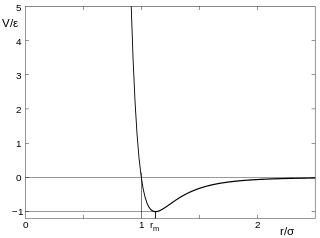
At the other extreme scale (nanometre/picometre; "microscopic theory"), the Lennard-Jones potential (also referred to  12-6 potential) is a model that "approximates" the interaction between a pair of atoms (neutral) or molecules [Lennard-Jones,1924; http://dx.doi.org/10.1098%2Frspa.1924.0082]. 
Ex-ample: Argon r0=0.335nm and E0 =0.01eV , the Lennard-Jones potential  is a potential energy:
r=r0 @ Ep=0.

"rm"

1/r^12    = approximation of The Pauli exclusion principle (no 2 identical fermions (particles with half-integer spin) may occupy the same quantum state simultaneously; a more rigorous statement is that the total wave function for two identical fermions is anti-symmetric with respect to exchange of the particles; http://en.wikipedia.org/wiki/Pauli_exclusion_principle).
1/r^6      = approximation of The van der Waals force (or van der Waals interaction)
The van der Waals force is the sum of the attractive or repulsive forces between molecules (or between parts of the same molecule) other than those due to covalent bonds or to the electrostatic interaction of ions with one another or with neutral molecules.
It includes 3 forces (http://en.wikipedia.org/wiki/Van_der_Waals_force):
-force between two permanent dipoles (Keesom force)
-force between a permanent dipole and a corresponding induced dipole (Debye force)
-force between two instantaneously induced dipoles (London dispersion force)

where ε is the "depth of the potential well", σ is the finite distance at which the inter-particle potential is zero, r is the distance between the particles, and  is the distance at which the potential reaches its minimum. At rm, the potential function has the value −ε. The distances are related as rm=2^(1/6)σ~1.225σ.
Whereas the functional form of the attractive term has a clear physical justification, the repulsive term has no theoretical justification. It is used because it approximates the Pauli repulsion well, and is more convenient due to the relative computational efficiency of calculating r^12 as the square of r^6 [http://en.wikipedia.org/wiki/Lennard-Jones_potential].
The L-J potential is particularly accurate for noble gas atoms (helium (He), neon (Ne), argon (Ar), krypton (Kr), xenon (Xe), and radon (Rn)) and is a good approximation at long and short distances for neutral atoms and molecules.

The Stockmayer potential [Stockmayer W. H.  J. Chem. Phys., 1941] or the 12-6-3 potential (a mathematical model for representing the interactions between pairs of atoms or molecules) consists of the Lennard-Jones potential with an embedded point dipole [http://en.wikipedia.org/wiki/Stockmayer_potential], [wikipedia-russian], [http://www.owlnet.rice.edu/~mjweeks/CHBE401_Project/Len-Jones/Len-Jones1.html], [googleBooks-H20-NH3], [liquid water: http://www.tandfonline.com/doi/abs/10.1080/002689797169916; http://pubs.acs.org/doi/abs/10.1021/ba-1983-0204.ch013]:

Assuming that the molecules interact as alined dipoles of maximum attraction, values for sigma, epsilon, and delta were determined for various polar molecules by a least squares fit of experimental viscosity data. Satisfactory results were obtained for slightly polar molecules, but not for more highly polar molecules (polar gases) such as NH3 or H2O [http://archive.org/details/nasa_techdoc_19980237089].
The Stockmayer term takes into account the increased repulsion between dipoles of similar orientation:

 When the orientation of the dipole is switched to opposite orientation, the plot shows the added attraction between the molecules.


Rem: the main quantity is = a potential well is the region surrounding a local minimum of potential energy. Energy captured in a potential well is "unable" to convert to another type of energy.

Bridge from macroscopic to microscopic physics: the Boltzmann constant, k (entropy), is a bridge between macroscopic and microscopic physics, since temperature (T) makes sense only in the macroscopic world, while the quantity kT gives a quantity of energy which is on the order of the average energy of a given atom in a substance with a temperature T. k=8.617×10⁻⁵ eV/K then 0.013eV, at room temperature.

In the case of bulk liquid water at room temperature, there are many models and many data: http://en.wikipedia.org/wiki/Water_model; http://en.wikipedia.org/wiki/Electromagnetic_absorption_by_water; http://en.wikipedia.org/wiki/Self-ionization_of_water; http://en.wikipedia.org/wiki/Water_(properties); http://omlc.ogi.edu/spectra/water/
The molecules of H20 are constantly moving in relation to each other, and the hydrogen bonds (highly directional hydrogen-bond network structure) are continually breaking and reforming at timescales faster than 250 femtoseconds [http://www.pnas.org/content/102/40/14171].
A water molecule can form a maximum of 4 hydrogen bonds because it can accept 2 and donate 2 hydrogen atoms. Other molecules (hydrogen fluoride, ammonia, methanol) form hydrogen bonds but they do not show anomalous behavior of thermodynamic, kinetic or structural properties like those observed in water. The answer to the apparent difference between water and other hydrogen bonding liquids lies in the fact that apart from water none of the hydrogen bonding molecules can form 4 hydrogen bonds, either due to an inability to donate/accept hydrogens or due to steric effects in bulky residues. In water, local tetrahedral order due to the 4 hydrogen bonds gives rise to an open structure and a 3-dimensional bonding network, resulting in the anomalous decrease of density when cooled below 4 °C.
Although hydrogen bonding is a relatively weak attraction compared to the covalent bonds within the water molecule itself, it is responsible for a number of water's physical properties. One such property is its relatively high melting and boiling point temperatures; more energy is required to break the hydrogen bonds between molecules. The extra bonding between water molecules also gives liquid water a large specific heat capacity. This high heat capacity makes water a good heat storage medium (coolant) and heat shield.
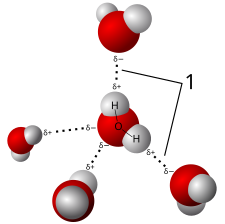
5-site model and 3-site model (Flexible SPC water)

In molecular dynamics simulations the flexible simple point charge water model (or Flexible SPC water; a re-parametrization of the 3-site SPC water model) gives the correct density and dielectric permittivity of water [Praprotnik,2004;http://www.sicmm.org/~praprot/publications/jp046158d.pdf]. Flexible SPC is implemented in the MDynaMix, Abalone programs... The SPC model assumes an ideal tetrahedral shape (HOH angle of 109.47°) instead of the observed angle of 104.5°.

----------------
Remark: Atomic units (a.u.) form a system of natural units which is especially convenient for nm or pm calculations. There are 2 different kinds of atomic units, which one might name Hartree atomic units and Rydberg atomic units, which differ in the choice of the unit of mass and charge.
Some particle has a mass m which is 2.4 times the mass of electron---2.4 a.u.
http://en.wikipedia.org/wiki/Atomic_units
-----------------

electron density and cloud

The Electron Localization Function ELF η(r) for a chemical system is a scalar field in 3D space.
http://www.cpfs.mpg.de/ELF/index.php?content=05graph.txt
Concerning the interpretation of the absolute values of ELF in the original paper [BECKE1990] the following hint was given: "... the upper limit ELF = 1 corresponding to perfect localization and the value ELF=½ corresponding to electron-gas-like pair probability". Two remarks can be made:
1.) Concerning the upper limit it may be justified that the authors interpret this value "corresponding to perfect localization" as they have given before their definition of "localization". However, in order to avoid confusion, e.g. with the much older physical concept of localized and itinerant electrons used in modern solid state electronic structure theory, the analysis of ELF should usually be performed in terms "high/low values of η" instead of "high/low electron localization". A simple example may serve as a demonstration: a single-determinant (Hartree-Fock or Kohn-Sham) solution for a H2 molecule gives one doubly occupied &sigma bonding orbital. The &eta(r) distribution is equal to 1.0 everywhere in space. Thus, in the sense of the above definition, each electron is "perfectly localized" at every point in space. Concluding this remark there certainly is a relation (to be found in the future) between the physical concept of localized and itinerant electrons and ELF but it seems to be a subtle one and the terms should not be intermixed.
2.) For the value η = ½ the authors give the absolutly correct interpretation. Any further interpretation of the &eta = ½ and lower values has to be justified strictly. Clearly, points or regions with &eta(r) = 0.5 for a chemical system do not imply "perfectly delocalized electrons".

For many years the size of atoms/molecules has been approximated by physical models in which the volumes of plastic balls describe where much of the electron density is to be found often sized to van der Waals radii. That is, the surface of these models is meant to represent a specific level of density of the electron cloud.

It is now relatively common to see images of surfaces that have been colored to show quantities such as electrostatic potential. Common surfaces in molecular visualization include solvent-accessible ("Lee-Richards") surfaces, solvent-excluded ("Connolly") surfaces, and isosurfaces. Opaque isosurfaces do not allow the atoms to be seen and identified and it is not easy to deduce them. Because of this, isosurfaces are often drawn with a degree of transparency.

In the last decade almost all of this technology has become commoditized. In 1992, Roger Sayle released his RasMol program into the public domain. MG continues to see innovation that balances technology and art, and currently zero-cost or open source programs such as PyMOL and Jmol have very wide use and acceptance. Recently the wide spread diffusion of advanced graphics hardware, has improved the rendering capabilities of the visualization tools. The capabilities of current shading languages allow the inclusion of advanced graphic effects (like ambient occlusion, cast shadows and non-photorealistic rendering techniques) in the interactive visualization of molecules. These graphic effects, beside being eye candy, can improve the comprehension of the three dimensional shapes of the molecules. An example of the effects that can be achieved exploiting recent graphics hardware can be seen in the simple open source visualization system QuteMol.

http://www.pymolwiki.org/index.php/MAC_Install
Forster-distance-calculator: Can be used as a pymol-python shortcut to calculate the Förster distance between dyes from different companies. Useful, if the user have pymol installed, but not python. This script is meant as a tool to finding the right dyes, when labelling suitable positions for the site-directed cysteine mutants.

Nowadays fitting of the molecular structure to the electron density map is largely automated by algorithms with computer graphics a guide to the process. An example is the XtalView XFit program (~100000 lines of C and Fortran).
http://www.duncanmcree.com/xtalview.html
----------
 example: http://demonstrations.wolfram.com/VanDerWaalsSurface/

---------------web services: visualizing molecular dynamics (from pdb file)
Molecules are "bouillaunantes" (@ T much greater than 0°K)
-tinker:
http://dasher.wustl.edu/tinker/downloads/bin-macosx-6.0.11.tar.gz
-motions that occur in proteins and other macromolecules: http://molmovdb.org/
-with Flexible SPC water model: PC &linux: http://sourceforge.net/projects/ascalaphgraphic/
-http://wishart.biology.ualberta.ca/moviemaker/

-This site provides tools for online normal mode calculation, even for large proteins and including all atoms, and algorithms that use normal modes for structural refinement or optimization:
http://lorentz.immstr.pasteur.fr/nomad-ref.php


---------------


For nano:

NanoEngineer-1 and QuteMol (viewer with many "realistics"):
-------------------------------------------

Electronic absorption spectra (one or multiphoton) and solvents

Which software can I use to calculate the effects of solvents on the electronic absorption spectra properties of molecules?
I mean spectra properties like transition energies, oscillator strength, transition moments and polarizabilities etc...
Gaussian 09 using the keyword: Solvent=(). In the users book you will find which solvents are available for calculating.
NWChem (http://www.nwchem-sw.org/index.php/Download). It is open source (100MB) and these types of calculations can be done either with continuum models or QM/MM. This is a tricky business. The continuum solvation model won't work if hydrogen bonds play a role in your case. Alternatively, you can represent the solvent explicitly. This needs a molecular simulation and afterwards you will average your result over several snapshots of your solute/solvent system. The latter computations would be done in a QM/MM fashion.
You see, it's getting hairy. But there has been some recent progress in this. Yet, the method - called polarizable embedding (PE) - is still in a developer's state. It is implemented in DALTON (for DFT and coupled cluster). Contact the authors of that method for a collaborative investigation.
Excited States in Solution through Polarizable Embedding; J. Chem. Theory Comput., 2010, 6 (12), pp 3721–3734; DOI: 10.1021/ct1003803: http://pubs.acs.org/doi/abs/10.1021/ct1003803
See also: Advances in Quantum Chemistry, Volume 61, chap 3, (40pages) 2011.
THE JOURNAL OF CHEMICAL PHYSICS 134, 104108 (2011), The polarizable embedding coupled cluster PE-CC method, Kristian Sneskov,Tobias Schwabe,Jacob Kongsted,Ove Christiansen: http://144.206.159.178/FT/18538/933480/16286981.pdf
GPU and NWchem: http://www.nvidia.com/object/molecular_dynamics.html
The calculation of excitation energies, one- and two-photon absorption properties, polarizabilities and
hyperpolarizabilities all coupled to a polarizable MM environment. Previously, one of us reported the
polarizable embedding density functional theory (PE-DFT) approach describing in the process the polarizable embedding Hartree–Fock (PE-HF) method. This is essential for this work since the reference orbitals are those from a PE-HF calculation.

They investigated the absorption spectrum of aqueous N-methyl acetamide (NMA; important building block of all proteins) with a specific focus on polarization effects. The formamide and NMA systems each consists of 120 conformations generated in a calibrated MD simulation containing roughly 250 water molecules. Previously, this has been shown to be sufficient to incorporate the bulk properties of water. All Photoactive yellow protein (PYP)  calculations are based on the x-ray structure of PYP  (PDB accession code 1nwz) with a reported accuracy of 0.82 Å.

The PE-CC strategy and calculations described in this paper have been implemented and carried out in a local version of the DALTON quantum chemistry program.
Dalton is an ab initio quantum chemistry software program, capable of calculating various molecular properties using the Hartree–Fock, MP2, MCSCF and coupled cluster theories. Version 2.0 of DALTON added support for density functional theory DFT calculations. DALTON by the Centre for Theoretical and Computational Chemistry. CTCC was founded by the Norwegian Research Council in 2007 and the duration of the project is 10 years. One main focus is on method development in electronic structure theory. http://dirac.chem.sdu.dk/daltonprogram.org
http://chem.au.dk/en/

---basics with mathematica:
http://demonstrations.wolfram.com/HydrogenOrbitals/
http://demonstrations.wolfram.com/TimeEvolutionOfAWavepacketInASquareWell/
http://demonstrations.wolfram.com/QuantumWellExplorer/
http://demonstrations.wolfram.com/BondingAndAntibondingMolecularOrbitals/

-------------------------

Nanostructures modeling at classical and quantum levels.

polymers, nanotubes, proteins, nucleic acids, quantum dots..., nanophotonics, nanofluidics...
a list of free computer programs:
http://en.wikipedia.org/wiki/Ascalaph_Designer (Flexible SPC water model, Implicit water model; Quantum chemistry with aid of CP2K and PC GAMESS/Firefly; Linux and XP)
http://en.wikipedia.org/wiki/CoNTub (CoNTub v2.0 (Released May-13-2011))
http://www.nanoengineer-1.com/content/
http://www.jcrystal.com/ (demo version; Nanotube Modeler is a program for generating xyz-coordinates of nano geometries (Nanotubes, Nanocones, Graphene sheets, Nano-holes, Viruses).JCrystal is a computer program for creating, editing, displaying and deploying crystal shapes. It also includes the JCrystalApplet for exporting interactive webpages.)
http://turin.nss.udel.edu/research/tubegenonline.html (Web-Accessible Nanotube Structure Generator and  TubeGen utility (stand alone))

http://en.wikipedia.org/wiki/Nanohub
nanoHUB.org is a science and engineering gateway
https://nanohub.org/resources/tools
https://nanohub.org/tools/qdot

For nanoparticules Silver, Gold, Nickel-Silver (surface plasmon resonance band)
A theoretical study of structural, electronic and optical properties of complexes, clusters and nanostructures:
https://sites.google.com/site/franckrabilloud/Home/research-interests
http://iopscience.iop.org/0953-4075/44/3/035101
Optical response of silver nanoclusters complexed with aromatic thiol molecules: a time-dependent density functional study; M Harb et al 2011 J. Phys. B: At. Mol. Opt. Phys. 44 035101 doi:10.1088/0953-4075/44/3/035101
----------------------------------------

Molecular Modeling Basics 

---> from  Jan H. Jensen
A big part of the motivation for my blog came from writing a book called Molecular Modeling Basics that was published in May, 2010 by CRC Press (http://www.crcpress.com/product/isbn/9781420075267). While writing the applications sections it was frustrating to turn the beautifully colored figures into black-and-white versions in order to keep the cost of the book reasonable.

Molecular Modeling in Chemical Education.

He creates Jmol applications for educational use, like this one, which animates rotational and vibrational energy states in water:
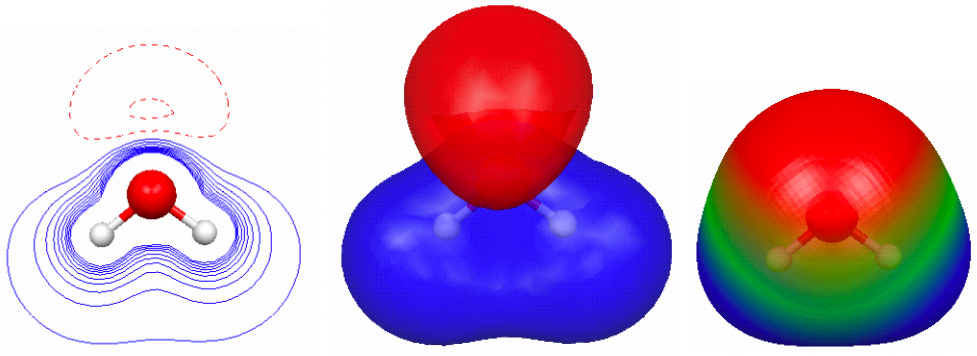
for water : Electrostatic potential maps

http://propka.ki.ku.dk/~luca/wiki/index.php/JansPage
http://molecularmodelingbasics.blogspot.fr/
http://molecularmodelingbasics.blogspot.fr/2012/04/virtual-molecular-modeling-kit.html
http://molecularmodelingbasics.blogspot.fr/search/label/transition%20metals
the strengths of interaction between methane, methane-water, and water dimer is due to their differences in polarity, which can be visualized using molecular electrostatic potentials (MEPs):
http://molecularmodelingbasics.blogspot.fr/2010/04/polarization-and-intermolecular.html
with  interactive Jmol versions with java: http://propka.ki.ku.dk/~jhjensen/fig4-16.html
http://propka.ki.ku.dk/~jhjensen/fig4-14.html

When molecules (CH4 and H20) attract:
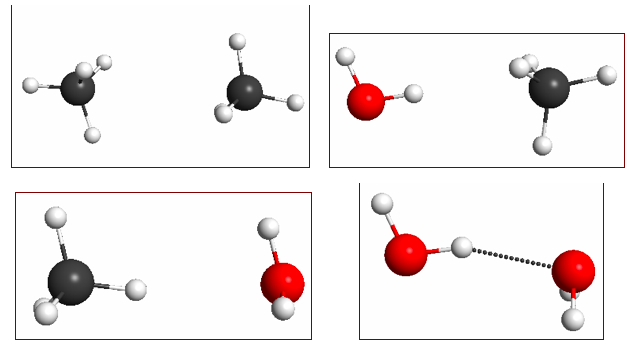
The molecular dimers shown in Figure 4.14 have very different interaction energies: -0.5, -1.0, -0.6, and -5.1 kcal/mol, respectively; which are reasonably well reproduced at the M06/6-31+G(2d,p)// M06/6-31G(d) level of theory: -0.4, -0.5, 0.0, and -4.9 kcal/mol.
The source of this difference in intermolecular attraction can be easily visualized with electrostatic potential maps (Figure 4.15). Methane is non-polar and the main source of attraction in the methane dimer is dispersive forces (which are hard to visualize). Water is polar, and the methane–water interaction (where the water is the H-donor) is a bit stronger than the methane dimer. This is due to an electrostatic interaction - more specifically polarization, but more about this in a future post.
0.002 au isodensity surface with superimposed molecular electrostatic potential for (a) methane dimer, (b) water–methane dimer where water acts as an H-bond donor, (c) water–methane dimer where methane acts as an H-bond donor, and (d) water dimer. The maximum potential value is 0.05 au and the level of theory is M06/6-31+G(2d,p)//M06/6-31G(d).
http://propka.ki.ku.dk/~jhjensen/fig4-15.html

Instructions on how to make interactive electrostatic potential maps with Jmol can be found here. Finally, I introduce a new feature (pop-up windows) to the blog because I can't figure out how to include Jmol buttons (which gives more control to the viewer) into blog posts. This feature also gives you access to the underlying GAMESS files as I have discussed here.

ions
http://molecularmodelingbasics.blogspot.fr/2010/02/im-positive.html

0.002 au isodensity surface with superimposed electrostatic potential of (a) Li+, (b) Na+, and (c) K+ ion. The maximum potential value is 0.8 au, and the level of theory is B3LYP/6-31G(d).


Why does the ionization energy decrease on from Li to Na to K? That's the same as asking why the electron affinities decrease on going from Li+ to Na+ to K+.

This Figure shows the ions colored by how positive they are at the surface (i.e. the electrostatic potential superimposed on the 0.002 isodensity surface). The darker the
color the more positive the ion, and it is clear that the Li+ ion is “more positive” than Na+, which is more positive than K+. Thus, more energy should be released when adding an electron to Li+ compared to Na+, and hence more energy is needed to remove an electron from Li
compared to Na (and similarly for K).

The reason why Li+ is “more positive” than Na+ or, more accurately, why the potential on the 0.002 au isodensity surface is more positive for Li+ than for Na+, is that the former is a smaller ion than the latter, so the surface is closer to the +1 charge at the center of the ion.


When making these figures it is very important to get the relative sizes of the ions correct, but this can be difficult since each image can be zoomed to an arbitrary size. He shows how to control this in MacMolPlt using the Manual Windows Parameter window.


"Ex-amples" with HF and "monopole, dipole, quadrupole":

Contour plot of the RHF/6-31G(d) electrostatic potential and 0.002 au isodensity surface of (a) CH3COO-, (b) HF, and (c) F2. The maximum/minimum contour values are, respectively, 0.5/0.025; 0.1/0.005; and 0.005/0.00025 au respectively. Blue corresponds to a negative potential. In each case the outer-most contour looks like the corresponding contour in the electrostatic potential due to a charge, dipole, and quadrupole, respectively.
----------------
TIPS:
Rotating molecules in PowerPoint
http://molecularmodelingbasics.blogspot.fr/2010/05/rotating-molecules-in-powerpoint.html
2 ways of doing this that are relatively easy.
One is to create an animated gif file using the Polyview3D web server, and inserting the file as a movie in Powerpoint.
http://polyview.cchmc.org/polyview3d.html With polyview3D many choices (pymol or rasmol)
 Another option is to set the molecule spinning in, for example, Avogadro and then simply record part of the screen using a screencasting program (for example  Screencast-o-matic is free, and can make mp4 files, which can be included in Powerpoint).


Tuesday, May 15, 2012

Mie scattering and cylinder

ICO Tool.exe allows the user to specify wavelength-dependent material refractive indexes for both the cylinder and surrounding medium, and to compute the optical scattering, absorption, and extinction as a function of wavelength or cylinder diameter. One can also specify the incident angle with respect to the axis of the cylinder.


ICOTool is a C# implementation of Mie theory for infinite cylinders. The physical solution is taken from Absorption and Scattering of Light by Small Particles by Bohren and Huffman. This program uses ALGLIB by Sergey Bochkanov and Vladimir Bystritsky, found online at www.alglib.net, and ZedGraph found at www.zedgraph.org.
  
http://www.physics.unc.edu/~aold/software.htm

Screen shot of the ICO tool

Friday, April 20, 2012

comparison between/comparaison entre "AMD E-300" and "pentium B960", low price laptop, pc portable de faible prix

Since 2012 jan, laptop low price (300-400$) = choice between :


  1. "AMD E-300" with chipset radeon  HD 6310  
  2. Intel "pentium B960" with chipset Intel graphics HD
    (intel  i3 with a  chipset Intel graphics HD 3000 ; better but  +40$)


For the last 2 or 3 years the focus has of the competition has shifted not only in the processor but also, how tightly you can integrate components external to the processors. There are some inherent advantages of the Integrated Graphics – including lower power consumption and availability of higher memory bandwidth.


- In performance, the Intel Pentium B960 is much better, especially in the CPU area.
- The AMD E-300 is however, a low power ( 18 Watts TDP), low cost processor that has decent integrated graphics.
- If you are looking for entry level processor with good graphics that will give you good batter life and will fit in thin notebooks, the E-300 is for you. For better CPU performance B960 is better.


http://compare-processors.com/intel-pentium-b960-vs-amd-e-300/2055/
http://compare-processors.com/intel-hd-graphics-3000-vs-am-radeon-hd-6310/1266/
http://www.cpu-world.com/news_2011/2011100402_Intel_introduces_Pentium_957_and_B960_and_Core_mobile_CPUs.html
-------------------------
Choisir des pc portables à 350-400 euros  = un choix entre deux systèmes:
"AMD E-300" avec son chipset radeon  HD 6310
et
Intel "pentium B960" avec son chipset Intel graphics HD
(choisir un processeur i3 car il a un  chipset Intel graphics HD 3000 à 40euros de plus)

chez Dell
http://www.grosbill.com/4-dell_inspiron_15_rouge_-157860-ordinateurs-portable_bureautique?utm_source=clubic&utm_medium=cpc&utm_campaign=157860-ordinateur%20portable&utm_content=

-variantes:
http://www.laptopspirit.fr/107715/toshiba-satellite-c670d-11l-a-419e-173-apu-zacate-dual-core-e-450-500-go-hdmi-maj.html
-autres
http://www.hardware.fr/prix/cat-700/portables.html?f%5B1105%5D%5B%5D=12374&f%5B782%5D%5B%5D=&f%5B783%5D%5B%5D=&f%5B784%5D%5B%5D=&f%5B786%5D%5B%5D=19041&f%5B789%5D%5B%5D=&f%5B787%5D%5B%5D=19961&f%5B791%5D%5B%5D=&f%5B794%5D%5B%5D=&f%5B796%5D%5B%5D=245751&f%5B1501%5D%5B%5D=&f%5B802%5D%5B%5D=&brands%5B%5D=0&mini=&maxi=&sort=1

Tuesday, February 7, 2012

how to create a new symbol with TeX ? A list of 5913 symbols and the corresponding LATEX commands that produce them

This document lists 5913 symbols and the corresponding LATEX commands that produce them. Some of these symbols are guaranteed to be available in every LATEX 2ε system; others require fonts and packages that may not accompany a given distribution and that therefore need to be installed. All of the fonts and packages used to prepare this document—as well as this document itself—are freely available from the Comprehensive TEX Archive Network (http://www.ctan.org/).

2) Body-text symbols
Table 1: LATEX 2ε Escapable “Special” Characters . . . . . . . . . . . . . . . . . . . . . . . . . . . 9
Table 2: Predefined LATEX 2ε Text-mode Commands . . . . . . . . . . . . . . . . . . . . . . . . . 9
Table 3: LATEX 2ε Commands Defined to Work in Both Math and Text Mode . . . . . . . 9
Table 4: AMS Commands Defined to Work in Both Math and Text Mode . . . . . . . . . . .10
Table 5: Non-ASCII Letters (Excluding Accented Letters) . . . . . . . . . . . . . . . . . . . . . . 10
Table 6: Letters Used to Typeset African Languages . . . . . . . . . . . . . . . . . . . . . . . . . 10
Table 7: Letters Used to Typeset Vietnamese . . . . . . . . . . . . . . . . . . . . . . . . . . . . . 10
Table 8: Punctuation Marks Not Found in OT1 . . . . . . . . . . . . . . . . . . . . . . . . . . . .10
Table 9: pifont Decorative Punctuation Marks . . . . . . . . . . . . . . . . . . . . . . . . . . . .10
Table 10: tipa Phonetic Symbols . . . . . . . . . . . . . . . . . . . . . . . . . . . . . . . . . . . . . 11
Table 11: tipx Phonetic Symbols . . . . . . . . . . . . . . . . . . . . . . . . . . . . . . . . . . . . . 12
Table 12: wsuipa Phonetic Symbols . . . . . . . . . . . . . . . . . . . . . . . . . . . . . . . . . . . . 13
Table 13: wasysym Phonetic Symbols . . . . . . . . . . . . . . . . . . . . . . . . . . . . . . . . . . . 13
Table 14: phonetic Phonetic Symbols . . . . . . . . . . . . . . . . . . . . . . . . . . . . . . . . . . . 13
Table 15: t4phonet Phonetic Symbols . . . . . . . . . . . . . . . . . . . . . . . . . . . . . . . . . . . 14
Table 16: semtrans Transliteration Symbols . . . . . . . . . . . . . . . . . . . . . . . . . . . . . 14
Table 17: Text-mode Accents . . . . . . . . . . . . . . . . . . . . . . . . . . . . . . . . . . . . . . . 14
Table 18: tipa Text-mode Accents . . . . . . . . . . . . . . . . . . . . . . . . . . . . . . . . . . . . 15
Table 19: extraipa Text-mode Accents . . . . . . . . . . . . . . . . . . . . . . . . . . . . . . . . . . 16
Table 20: wsuipa Text-mode Accents . . . . . . . . . . . . . . . . . . . . . . . . . . . . . . . . . . . 16
Table 21: phonetic Text-mode Accents . . . . . . . . . . . . . . . . . . . . . . . . . . . . . . . . . 16
Table 22: metre Text-mode Accents . . . . . . . . . . . . . . . . . . . . . . . . . . . . . . . . . . . 17
Table 23: t4phonet Text-mode Accents . . . . . . . . . . . . . . . . . . . . . . . . . . . . . . . . .17
Table 24: arcs Text-mode Accents . . . . . . . . . . . . . . . . . . . . . . . . . . . . . . . . . . . . 17
Table 25: semtrans Accents . . . . . . . . . . . . . . . . . . . . . . . . . . . . . . . . . . . . . . . . 17
Table 26: ogonek Accents . . . . . . . . . . . . . . . . . . . . . . . . . . . . . . . . . . . . . . . . . 17
Table 27: combelow Accents . . . . . . . . . . . . . . . . . . . . . . . . . . . . . . . . . . . . . . .17

Table 28: wsuipa Diacritics . . . . . . . . . . . . . . . . . . . . . . . . . . . . . . . . . . . . . . . . 18
Table 29: textcomp Diacritics . . . . . . . . . . . . . . . . . . . . . . . . . . . . . . . . . . . . . . . 18
Table 30: textcomp Currency Symbols . . . . . . . . . . . . . . . . . . . . . . . . . . . . . . . . . . 18
Table 31: marvosym Currency Symbols . . . . . . . . . . . . . . . . . . . . . . . . . . . . . . . . . . 18
Table 32: wasysym Currency Symbols . . . . . . . . . . . . . . . . . . . . . . . . . . . . . . . . . . 18
Table 33: ChinA2e Currency Symbols . . . . . . . . . . . . . . . . . . . . . . . . . . . . . . . . . . . 19
Table 34: teubner Currency Symbols . . . . . . . . . . . . . . . . . . . . . . . . . . . . . . . . . . . 19
Table 35: eurosym Euro Signs . . . . . . . . . . . . . . . . . . . . . . . . . . . . . . . . . . . . . . . 19
Table 36: fourier Euro Signs . . . . . . . . . . . . . . . . . . . . . . . . . . . . . . . . . . . . . . . . 19
Table 37: textcomp Legal Symbols . . . . . . . . . . . . . . . . . . . . . . . . . . . . . . . . . . . . 19
Table 38: cclicenses Creative Commons License Icons . . . . . . . . . . . . . . . . . . . . . .19
Table 39: textcomp Old-style Numerals . . . . . . . . . . . . . . . . . . . . . . . . . . . . . . . . . . 20
Table 40: Miscellaneous textcomp Symbols . . . . . . . . . . . . . . . . . . . . . . . . . . . . . . . . 20
Table 41: Miscellaneous wasysym Text-mode Symbols . . . . . . . . . . . . . . . . . . . . . . . . . 20


3) Mathematical symbols
Table 42: Math-Mode Versions of Text Symbols . . . . . . . . . . . . . . . . . . . . . . . . . . . . . 21
Table 43: cmll Unary Operators . . . . . . . . . . . . . . . . . . . . . . . . . . . . . . . . . . . . . . 21
Table 44: Binary Operators . . . . . . . . . . . . . . . . . . . . . . . . . . . . . . . . . . . . . . . . 22
Table 45: AMS Binary Operators . . . . . . . . . . . . . . . . . . . . . . . . . . . . . . . . . . . . 22
Table 46: stmaryrd Binary Operators . . . . . . . . . . . . . . . . . . . . . . . . . . . . . . . . . . . 22
Table 47: wasysym Binary Operators . . . . . . . . . . . . . . . . . . . . . . . . . . . . . . . . . . . 23
Table 48: txfonts/pxfonts Binary Operators . . . . . . . . . . . . . . . . . . . . . . . . . . . . . . . 23
Table 49: mathabx Binary Operators . . . . . . . . . . . . . . . . . . . . . . . . . . . . . . . . . . . 23
Table 50: MnSymbol Binary Operators . . . . . . . . . . . . . . . . . . . . . . . . . . . . . . . . . . 23
Table 51: mathdesign Binary Operators . . . . . . . . . . . . . . . . . . . . . . . . . . . . . . . . . 24
Table 52: cmll Binary Operators . . . . . . . . . . . . . . . . . . . . . . . . . . . . . . . . . . . . . 24
Table 53: shuffle Binary Operators . . . . . . . . . . . . . . . . . . . . . . . . . . . . . . . . . . . . 24
Table 54: ulsy Geometric Binary Operators . . . . . . . . . . . . . . . . . . . . . . . . . . . . . . . 24
Table 55: mathabx Geometric Binary Operators . . . . . . . . . . . . . . . . . . . . . . . . . . . . . 25
Table 56: MnSymbol Geometric Binary Operators . . . . . . . . . . . . . . . . . . . . . . . . . . . . 25
Table 57: Variable-sized Math Operators . . . . . . . . . . . . . . . . . . . . . . . . . . . . . . . . 25
Table 58: AMS Variable-sized Math Operators . . . . . . . . . . . . . . . . . . . . . . . . . . . . . 26
Table 59: stmaryrd Variable-sized Math Operators . . . . . . . . . . . . . . . . . . . . . . . . . . . 26
Table 60: wasysym Variable-sized Math Operators . . . . . . . . . . . . . . . . . . . . . . . . . . . 26
Table 61: mathabx Variable-sized Math Operators . . . . . . . . . . . . . . . . . . . . . . . . . . . 26
Table 62: txfonts/pxfonts Variable-sized Math Operators . . . . . . . . . . . . . . . . . . . . . . . . 27
Table 63: esint Variable-sized Math Operators . . . . . . . . . . . . . . . . . . . . . . . . . . . . . . 28
Table 64: MnSymbol Variable-sized Math Operators . . . . . . . . . . . . . . . . . . . . . . . . . . 29
Table 65: mathdesign Variable-sized Math Operators . . . . . . . . . . . . . . . . . . . . . . . . . . 30
Table 66: cmll Large Math Operators . . . . . . . . . . . . . . . . . . . . . . . . . . . . . . . . . . 30
Table 67: Binary Relations . . . . . . . . . . . . . . . . . . . . . . . . . . . . . . . . . . . . . . . . 30
Table 68: AMS Binary Relations . . . . . . . . . . . . . . . . . . . . . . . . . . . . . . . . . . . . . 30
Table 69: AMS Negated Binary Relations . . . . . . . . . . . . . . . . . . . . . . . . . . . . . . . . 31
Table 70: stmaryrd Binary Relations . . . . . . . . . . . . . . . . . . . . . . . . . . . . . . . . . . . 31
Table 71: wasysym Binary Relations . . . . . . . . . . . . . . . . . . . . . . . . . . . . . . . . . . . 31
Table 72: txfonts/pxfonts Binary Relations . . . . . . . . . . . . . . . . . . . . . . . . . . . . . . . . 31
Table 73: txfonts/pxfonts Negated Binary Relations . . . . . . . . . . . . . . . . . . . . . . . . . . . 31
Table 74: mathabx Binary Relations . . . . . . . . . . . . . . . . . . . . . . . . . . . . . . . . . . . 32
Table 75: mathabx Negated Binary Relations . . . . . . . . . . . . . . . . . . . . . . . . . . . . . . 32
Table 76: MnSymbol Binary Relations . . . . . . . . . . . . . . . . . . . . . . . . . . . . . . . . . . 32
Table 77: MnSymbol Negated Binary Relations . . . . . . . . . . . . . . . . . . . . . . . . . . . . . 33
Table 78: mathtools Binary Relations . . . . . . . . . . . . . . . . . . . . . . . . . . . . . . . . . . . 34
Table 79: turnstile Binary Relations . . . . . . . . . . . . . . . . . . . . . . . . . . . . . . . . . . . . 35
Table 80: trsym Binary Relations . . . . . . . . . . . . . . . . . . . . . . . . . . . . . . . . . . . . . 36
Table 81: trfsigns Binary Relations . . . . . . . . . . . . . . . . . . . . . . . . . . . . . . . . . . . . 36
Table 82: cmll Binary Relations . . . . . . . . . . . . . . . . . . . . . . . . . . . . . . . . . . . . . . 36
Table 83: colonequals Binary Relations . . . . . . . . . . . . . . . . . . . . . . . . . . . . . . . . . . 36 

Table 84: fourier Binary Relations . . . . . . . . . . . . . . . . . . . . . . . . . . . . . . . . . . . . 36
Table 85: Subset and Superset Relations . . . . . . . . . . . . . . . . . . . . . . . . . . . . . . . . . 36
Table 86: AMS Subset and Superset Relations . . . . . . . . . . . . . . . . . . . . . . . . . . . . . 36
Table 87: stmaryrd Subset and Superset Relations . . . . . . . . . . . . . . . . . . . . . . . . . . . . 37
Table 88: wasysym Subset and Superset Relations . . . . . . . . . . . . . . . . . . . . . . . . . . . . 37
Table 89: txfonts/pxfonts Subset and Superset Relations . . . . . . . . . . . . . . . . . . . . . . . . 37
Table 90: mathabx Subset and Superset Relations . . . . . . . . . . . . . . . . . . . . . . . . . . . . 37
Table 91: MnSymbol Subset and Superset Relations . . . . . . . . . . . . . . . . . . . . . . . . . . 37
Table 92: Inequalities . . . . . . . . . . . . . . . . . . . . . . . . . . . . . . . . . . . . . . . . . . . 37
Table 93: AMS Inequalities . . . . . . . . . . . . . . . . . . . . . . . . . . . . . . . . . . . . . . . . 38
Table 94: wasysym Inequalities . . . . . . . . . . . . . . . . . . . . . . . . . . . . . . . . . . . . . . 38
Table 95: txfonts/pxfonts Inequalities . . . . . . . . . . . . . . . . . . . . . . . . . . . . . . . . . . . 38
Table 96: mathabx Inequalities . . . . . . . . . . . . . . . . . . . . . . . . . . . . . . . . . . . . . . 38
Table 97: MnSymbol Inequalities . . . . . . . . . . . . . . . . . . . . . . . . . . . . . . . . . . . . . 39
Table 98: AMS Triangle Relations . . . . . . . . . . . . . . . . . . . . . . . . . . . . . . . . . . . . 39
Table 99: stmaryrd Triangle Relations . . . . . . . . . . . . . . . . . . . . . . . . . . . . . . . . . . 40
Table 100: mathabx Triangle Relations . . . . . . . . . . . . . . . . . . . . . . . . . . . . . . . . . . 40
Table 101: MnSymbol Triangle Relations . . . . . . . . . . . . . . . . . . . . . . . . . . . . . . . . . 40
Table 102: Arrows . . . . . . . . . . . . . . . . . . . . . . . . . . . . . . . . . . . . . . . . . . . . . . 41
Table 103: Harpoons . . . . . . . . . . . . . . . . . . . . . . . . . . . . . . . . . . . . . . . . . . . . 41
Table 104: textcomp Text-mode Arrows . . . . . . . . . . . . . . . . . . . . . . . . . . . . . . . . . . 41
Table 105: AMS Arrows . . . . . . . . . . . . . . . . . . . . . . . . . . . . . . . . . . . . . . . . . . 41
Table 106: AMS Negated Arrows . . . . . . . . . . . . . . . . . . . . . . . . . . . . . . . . . . . . . 41
Table 107: AMS Harpoons . . . . . . . . . . . . . . . . . . . . . . . . . . . . . . . . . . . . . . . . . 41
Table 108: stmaryrd Arrows . . . . . . . . . . . . . . . . . . . . . . . . . . . . . . . . . . . . . . . . . 42
Table 109: txfonts/pxfonts Arrows . . . . . . . . . . . . . . . . . . . . . . . . . . . . . . . . . . . . . 42
Table 110: mathabx Arrows . . . . . . . . . . . . . . . . . . . . . . . . . . . . . . . . . . . . . . . . . 42
Table 111: mathabx Negated Arrows . . . . . . . . . . . . . . . . . . . . . . . . . . . . . . . . . . . . 42
Table 112: mathabx Harpoons . . . . . . . . . . . . . . . . . . . . . . . . . . . . . . . . . . . . . . . 43
Table 113: MnSymbol Arrows . . . . . . . . . . . . . . . . . . . . . . . . . . . . . . . . . . . . . . . . 43
Table 114: MnSymbol Negated Arrows . . . . . . . . . . . . . . . . . . . . . . . . . . . . . . . . . . . 44
Table 115: MnSymbol Harpoons . . . . . . . . . . . . . . . . . . . . . . . . . . . . . . . . . . . . . . 46
Table 116: MnSymbol Negated Harpoons . . . . . . . . . . . . . . . . . . . . . . . . . . . . . . . . . 46
Table 117: harpoon Extensible Harpoons . . . . . . . . . . . . . . . . . . . . . . . . . . . . . . . . . 47
Table 118: chemarrow Arrows . . . . . . . . . . . . . . . . . . . . . . . . . . . . . . . . . . . . . . . . 47
Table 119: fge Arrows . . . . . . . . . . . . . . . . . . . . . . . . . . . . . . . . . . . . . . . . . . . . 47
Table 120: MnSymbol Spoons . . . . . . . . . . . . . . . . . . . . . . . . . . . . . . . . . . . . . . . . 47
Table 121: MnSymbol Pitchforks . . . . . . . . . . . . . . . . . . . . . . . . . . . . . . . . . . . . . . 47
Table 122: MnSymbol Smiles and Frowns . . . . . . . . . . . . . . . . . . . . . . . . . . . . . . . . . 48
Table 123: ulsy Contradiction Symbols . . . . . . . . . . . . . . . . . . . . . . . . . . . . . . . . . . 48
Table 124: Extension Characters . . . . . . . . . . . . . . . . . . . . . . . . . . . . . . . . . . . . . . 48
Table 125: stmaryrd Extension Characters . . . . . . . . . . . . . . . . . . . . . . . . . . . . . . . . . 48
Table 126: txfonts/pxfonts Extension Characters . . . . . . . . . . . . . . . . . . . . . . . . . . . . . 48
Table 127: mathabx Extension Characters . . . . . . . . . . . . . . . . . . . . . . . . . . . . . . . . . 49
Table 128: Log-like Symbols . . . . . . . . . . . . . . . . . . . . . . . . . . . . . . . . . . . . . . . . 49
Table 129: AMS Log-like Symbols . . . . . . . . . . . . . . . . . . . . . . . . . . . . . . . . . . . . . 49
Table 130: ChinA2e Number Sets . . . . . . . . . . . . . . . . . . . . . . . . . . . . . . . . . . . . . . 49
Table 131: Greek Letters . . . . . . . . . . . . . . . . . . . . . . . . . . . . . . . . . . . . . . . . . . 50
Table 132: AMS Greek Letters . . . . . . . . . . . . . . . . . . . . . . . . . . . . . . . . . . . . . . . 50
Table 133: txfonts/pxfonts Upright Greek Letters . . . . . . . . . . . . . . . . . . . . . . . . . . . . . 50
Table 134: upgreek Upright Greek Letters . . . . . . . . . . . . . . . . . . . . . . . . . . . . . . . . . 51
Table 135: fourier Variant Greek Letters . . . . . . . . . . . . . . . . . . . . . . . . . . . . . . . . . . 51
Table 136: txfonts/pxfonts Variant Latin Letters . . . . . . . . . . . . . . . . . . . . . . . . . . . . . 51
Table 137: AMS Hebrew Letters . . . . . . . . . . . . . . . . . . . . . . . . . . . . . . . . . . . . . . 51
Table 138: MnSymbol Hebrew Letters . . . . . . . . . . . . . . . . . . . . . . . . . . . . . . . . . . . 51
Table 139: Letter-like Symbols . . . . . . . . . . . . . . . . . . . . . . . . . . . . . . . . . . . . . . . 51
Table 140: AMS Letter-like Symbols . . . . . . . . . . . . . . . . . . . . . . . . . . . . . . . . . . . 52
 Table 141: txfonts/pxfonts Letter-like Symbols . . . . . . . . . . . . . . . . . . . . . . . . . . . . . . 52
Table 142: mathabx Letter-like Symbols . . . . . . . . . . . . . . . . . . . . . . . . . . . . . . . . . . 52
Table 143: MnSymbol Letter-like Symbols . . . . . . . . . . . . . . . . . . . . . . . . . . . . . . . . . 52
Table 144: trfsigns Letter-like Symbols . . . . . . . . . . . . . . . . . . . . . . . . . . . . . . . . . . . 52
Table 145: mathdesign Letter-like Symbols . . . . . . . . . . . . . . . . . . . . . . . . . . . . . . . . 52
Table 146: fge Letter-like Symbols . . . . . . . . . . . . . . . . . . . . . . . . . . . . . . . . . . . . . 53
Table 147: fourier Letter-like Symbols . . . . . . . . . . . . . . . . . . . . . . . . . . . . . . . . . . . 53
Table 148: AMS Delimiters . . . . . . . . . . . . . . . . . . . . . . . . . . . . . . . . . . . . . . . . . 53
Table 149: stmaryrd Delimiters . . . . . . . . . . . . . . . . . . . . . . . . . . . . . . . . . . . . . . . 53
Table 150: mathabx Delimiters . . . . . . . . . . . . . . . . . . . . . . . . . . . . . . . . . . . . . . . 53
Table 151: nath Delimiters . . . . . . . . . . . . . . . . . . . . . . . . . . . . . . . . . . . . . . . . . 53
Table 152: Variable-sized Delimiters . . . . . . . . . . . . . . . . . . . . . . . . . . . . . . . . . . . . 54
Table 153: Large, Variable-sized Delimiters . . . . . . . . . . . . . . . . . . . . . . . . . . . . . . . . 54
Table 154: AMS Variable-sized Delimiters . . . . . . . . . . . . . . . . . . . . . . . . . . . . . . . . 54
Table 155: stmaryrd Variable-sized Delimiters . . . . . . . . . . . . . . . . . . . . . . . . . . . . . . . 54
Table 156: mathabx Variable-sized Delimiters . . . . . . . . . . . . . . . . . . . . . . . . . . . . . . . 55
Table 157: MnSymbol Variable-sized Delimiters . . . . . . . . . . . . . . . . . . . . . . . . . . . . . . 55
Table 158: mathdesign Variable-sized Delimiters . . . . . . . . . . . . . . . . . . . . . . . . . . . . . 56
Table 159: nath Variable-sized Delimiters (Double) . . . . . . . . . . . . . . . . . . . . . . . . . . . . 56
Table 160: nath Variable-sized Delimiters (Triple) . . . . . . . . . . . . . . . . . . . . . . . . . . . . 57
Table 161: fourier Variable-sized Delimiters . . . . . . . . . . . . . . . . . . . . . . . . . . . . . . . . 57
Table 162: textcomp Text-mode Delimiters . . . . . . . . . . . . . . . . . . . . . . . . . . . . . . . . 57
Table 163: metre Text-mode Delimiters . . . . . . . . . . . . . . . . . . . . . . . . . . . . . . . . . . 57
Table 164: Math-mode Accents . . . . . . . . . . . . . . . . . . . . . . . . . . . . . . . . . . . . . . 57
Table 165: AMS Math-mode Accents . . . . . . . . . . . . . . . . . . . . . . . . . . . . . . . . . . . 58
Table 166: MnSymbol Math-mode Accents . . . . . . . . . . . . . . . . . . . . . . . . . . . . . . . . 58
Table 167: fge Math-mode Accents . . . . . . . . . . . . . . . . . . . . . . . . . . . . . . . . . . . . 58
Table 168: yhmath Math-mode Accents . . . . . . . . . . . . . . . . . . . . . . . . . . . . . . . . . . 58
Table 169: Extensible Accents . . . . . . . . . . . . . . . . . . . . . . . . . . . . . . . . . . . . . . . 59
Table 170: overrightarrow Extensible Accents . . . . . . . . . . . . . . . . . . . . . . . . . . . . . . . 59
Table 171: yhmath Extensible Accents . . . . . . . . . . . . . . . . . . . . . . . . . . . . . . . . . . . 59
Table 172: AMS Extensible Accents . . . . . . . . . . . . . . . . . . . . . . . . . . . . . . . . . . . . 59
Table 173: MnSymbol Extensible Accents . . . . . . . . . . . . . . . . . . . . . . . . . . . . . . . . . 60
Table 174: mathtools Extensible Accents . . . . . . . . . . . . . . . . . . . . . . . . . . . . . . . . . 60
Table 175: mathabx Extensible Accents . . . . . . . . . . . . . . . . . . . . . . . . . . . . . . . . . . 60
Table 176: fourier Extensible Accents . . . . . . . . . . . . . . . . . . . . . . . . . . . . . . . . . . . 60
Table 177: esvect Extensible Accents . . . . . . . . . . . . . . . . . . . . . . . . . . . . . . . . . . . 61
Table 178: undertilde Extensible Accents . . . . . . . . . . . . . . . . . . . . . . . . . . . . . . . . . 61
Table 179: ushort Extensible Accents . . . . . . . . . . . . . . . . . . . . . . . . . . . . . . . . . . . 61
Table 180: AMS Extensible Arrows . . . . . . . . . . . . . . . . . . . . . . . . . . . . . . . . . . . . 61
Table 181: mathtools Extensible Arrows . . . . . . . . . . . . . . . . . . . . . . . . . . . . . . . . . . 62
Table 182: chemarr Extensible Arrows . . . . . . . . . . . . . . . . . . . . . . . . . . . . . . . . . . . 62
Table 183: chemarrow Extensible Arrows . . . . . . . . . . . . . . . . . . . . . . . . . . . . . . . . . 62
Table 184: extarrows Extensible Arrows . . . . . . . . . . . . . . . . . . . . . . . . . . . . . . . . . . 62
Table 185: extpfeil Extensible Arrows . . . . . . . . . . . . . . . . . . . . . . . . . . . . . . . . . . . 63
Table 186: DotArrow Extensible Arrows . . . . . . . . . . . . . . . . . . . . . . . . . . . . . . . . . . 63
Table 187: trfsigns Extensible Transform Symbols . . . . . . . . . . . . . . . . . . . . . . . . . . . . 63
Table 188: holtpolt Non-commutative Division Symbols . . . . . . . . . . . . . . . . . . . . . . . . . 63
Table 189: Dots . . . . . . . . . . . . . . . . . . . . . . . . . . . . . . . . . . . . . . . . . . . . . . . 63
Table 190: AMS Dots . . . . . . . . . . . . . . . . . . . . . . . . . . . . . . . . . . . . . . . . . . . . 64
Table 191: wasysym Dots . . . . . . . . . . . . . . . . . . . . . . . . . . . . . . . . . . . . . . . . . . 64
Table 192: MnSymbol Dots . . . . . . . . . . . . . . . . . . . . . . . . . . . . . . . . . . . . . . . . . 64
Table 193: mathdots Dots . . . . . . . . . . . . . . . . . . . . . . . . . . . . . . . . . . . . . . . . . . 64
Table 194: yhmath Dots . . . . . . . . . . . . . . . . . . . . . . . . . . . . . . . . . . . . . . . . . . . 64
Table 195: teubner Dots . . . . . . . . . . . . . . . . . . . . . . . . . . . . . . . . . . . . . . . . . . . 64
Table 196: mathcomp Math Symbols . . . . . . . . . . . . . . . . . . . . . . . . . . . . . . . . . . . . 65
Table 197: marvosym Digits . . . . . . . . . . . . . . . . . . . . . . . . . . . . . . . . . . . . . . . . . 65
Table 198: fge Digits . . . . . . . . . . . . . . . . . . . . . . . . . . . . . . . . . . . . . . . . . . . . 65
Table 199: dozenal Base-12 Digits . . . . . . . . . . . . . . . . . . . . . . . . . . . . . . . . . . . . . 65
Table 200: mathabx Mayan Digits . . . . . . . . . . . . . . . . . . . . . . . . . . . . . . . . . . . . . 65
Table 201: Miscellaneous LATEX 2ε Math Symbols . . . . . . . . . . . . . . . . . . . . . . . . . . . . 65
Table 202: Miscellaneous AMS Math Symbols . . . . . . . . . . . . . . . . . . . . . . . . . . . . . . 66
Table 203: Miscellaneous wasysym Math Symbols . . . . . . . . . . . . . . . . . . . . . . . . . . . . 66
Table 204: Miscellaneous txfonts/pxfonts Math Symbols . . . . . . . . . . . . . . . . . . . . . . . . . 66
Table 205: Miscellaneous mathabx Math Symbols . . . . . . . . . . . . . . . . . . . . . . . . . . . . 66
Table 206: Miscellaneous MnSymbol Math Symbols . . . . . . . . . . . . . . . . . . . . . . . . . . . 66
Table 207: Miscellaneous Internal MnSymbol Math Symbols . . . . . . . . . . . . . . . . . . . . . . 67
Table 208: Miscellaneous textcomp Text-mode Math Symbols . . . . . . . . . . . . . . . . . . . . . . 67
Table 209: Miscellaneous marvosym Math Symbols . . . . . . . . . . . . . . . . . . . . . . . . . . . . 67
Table 210: Miscellaneous fge Math Symbols . . . . . . . . . . . . . . . . . . . . . . . . . . . . . . . 67
Table 211: Miscellaneous mathdesign Math Symbols . . . . . . . . . . . . . . . . . . . . . . . . . . . 67
Table 212: Miscellaneous arev Math Symbols . . . . . . . . . . . . . . . . . . . . . . . . . . . . . . . 67
Table 213: Math Alphabets . . . . . . . . . . . . . . . . . . . . . . . . . . . . . . . . . . . . . . . . . 68


4) Science and technology symbols
Table 214: gensymb Symbols Defined to Work in Both Math and Text Mode . . . . . . . . . . . . . 70
Table 215: wasysym Electrical and Physical Symbols . . . . . . . . . . . . . . . . . . . . . . . . . . . 70
Table 216: ifsym Pulse Diagram Symbols . . . . . . . . . . . . . . . . . . . . . . . . . . . . . . . . . 70
Table 217: ar Aspect Ratio Symbol . . . . . . . . . . . . . . . . . . . . . . . . . . . . . . . . . . . . 70
Table 218: textcomp Text-mode Science and Engineering Symbols . . . . . . . . . . . . . . . . . . . 70
Table 219: steinmetz Extensible Phasor Symbol . . . . . . . . . . . . . . . . . . . . . . . . . . . . . 70
Table 220: wasysym Astronomical Symbols . . . . . . . . . . . . . . . . . . . . . . . . . . . . . . . . 71
Table 221: marvosym Astronomical Symbols . . . . . . . . . . . . . . . . . . . . . . . . . . . . . . . 71
Table 222: mathabx Astronomical Symbols . . . . . . . . . . . . . . . . . . . . . . . . . . . . . . . . 71
Table 223: wasysym APL Symbols . . . . . . . . . . . . . . . . . . . . . . . . . . . . . . . . . . . . . 71
Table 224: wasysym APL Modifiers . . . . . . . . . . . . . . . . . . . . . . . . . . . . . . . . . . . . 71
Table 225: marvosym Computer Hardware Symbols . . . . . . . . . . . . . . . . . . . . . . . . . . . 72
Table 226: keystroke Computer Keys . . . . . . . . . . . . . . . . . . . . . . . . . . . . . . . . . . . . 72
Table 227: ascii Control Characters (CP437) . . . . . . . . . . . . . . . . . . . . . . . . . . . . . . . 72
Table 228: milstd Logic Gates . . . . . . . . . . . . . . . . . . . . . . . . . . . . . . . . . . . . . . . 73
Table 229: marvosym Communication Symbols . . . . . . . . . . . . . . . . . . . . . . . . . . . . . . 73
Table 230: marvosym Engineering Symbols . . . . . . . . . . . . . . . . . . . . . . . . . . . . . . . . 73
Table 231: wasysym Biological Symbols . . . . . . . . . . . . . . . . . . . . . . . . . . . . . . . . . . 73
Table 232: marvosym Biological Symbols . . . . . . . . . . . . . . . . . . . . . . . . . . . . . . . . . 74
Table 233: marvosym Safety-related Symbols . . . . . . . . . . . . . . . . . . . . . . . . . . . . . . . 74
Table 234: feyn Feynman Diagram Symbols . . . . . . . . . . . . . . . . . . . . . . . . . . . . . . . . 74


5) Dingbats
Table 235: bbding Arrows . . . . . . . . . . . . . . . . . . . . . . . . . . . . . . . . . . . . . . . . . . 75
Table 236: pifont Arrows . . . . . . . . . . . . . . . . . . . . . . . . . . . . . . . . . . . . . . . . . . 75
Table 237: universal Arrows . . . . . . . . . . . . . . . . . . . . . . . . . . . . . . . . . . . . . . . . . 75
Table 238: marvosym Scissors . . . . . . . . . . . . . . . . . . . . . . . . . . . . . . . . . . . . . . . . 75
Table 239: bbding Scissors . . . . . . . . . . . . . . . . . . . . . . . . . . . . . . . . . . . . . . . . . 75
Table 240: pifont Scissors . . . . . . . . . . . . . . . . . . . . . . . . . . . . . . . . . . . . . . . . . . 75
Table 241: dingbat Pencils . . . . . . . . . . . . . . . . . . . . . . . . . . . . . . . . . . . . . . . . . 76
Table 242: bbding Pencils and Nibs . . . . . . . . . . . . . . . . . . . . . . . . . . . . . . . . . . . . 76
Table 243: pifont Pencils and Nibs . . . . . . . . . . . . . . . . . . . . . . . . . . . . . . . . . . . . . 76
Table 244: dingbat Fists . . . . . . . . . . . . . . . . . . . . . . . . . . . . . . . . . . . . . . . . . . . 76
Table 245: bbding Fists . . . . . . . . . . . . . . . . . . . . . . . . . . . . . . . . . . . . . . . . . . . 76
Table 246: pifont Fists . . . . . . . . . . . . . . . . . . . . . . . . . . . . . . . . . . . . . . . . . . . . 76
Table 247: fourier Fists . . . . . . . . . . . . . . . . . . . . . . . . . . . . . . . . . . . . . . . . . . . 76
Table 248: bbding Crosses and Plusses . . . . . . . . . . . . . . . . . . . . . . . . . . . . . . . . . . . 76
Table 249: pifont Crosses and Plusses . . . . . . . . . . . . . . . . . . . . . . . . . . . . . . . . . . . 77
Table 250: bbding Xs and Check Marks . . . . . . . . . . . . . . . . . . . . . . . . . . . . . . . . . . 77
Table 251: pifont Xs and Check Marks . . . . . . . . . . . . . . . . . . . . . . . . . . . . . . . . . . 77
Table 252: wasysym Xs and Check Marks . . . . . . . . . . . . . . . . . . . . . . . . . . . . . . . . . 77
Table 253: universal Xs . . . . . . . . . . . . . . . . . . . . . . . . . . . . . . . . . . . . . . . . . . . 77
Table 254: pifont Circled Numbers . . . . . . . . . . . . . . . . . . . . . . . . . . . . . . . . . . . . . 77
Table 255: wasysym Stars . . . . . . . . . . . . . . . . . . . . . . . . . . . . . . . . . . . . . . . . . . 77
Table 256: bbding Stars, Flowers, and Similar Shapes . . . . . . . . . . . . . . . . . . . . . . . . . . 78
Table 257: pifont Stars, Flowers, and Similar Shapes . . . . . . . . . . . . . . . . . . . . . . . . . . . 78
Table 258: fourier Ornaments . . . . . . . . . . . . . . . . . . . . . . . . . . . . . . . . . . . . . . . . 78
Table 259: wasysym Geometric Shapes . . . . . . . . . . . . . . . . . . . . . . . . . . . . . . . . . . . 78
Table 260: MnSymbol Geometric Shapes . . . . . . . . . . . . . . . . . . . . . . . . . . . . . . . . . 79
Table 261: ifsym Geometric Shapes . . . . . . . . . . . . . . . . . . . . . . . . . . . . . . . . . . . . 79
Table 262: bbding Geometric Shapes . . . . . . . . . . . . . . . . . . . . . . . . . . . . . . . . . . . . 80
Table 263: pifont Geometric Shapes . . . . . . . . . . . . . . . . . . . . . . . . . . . . . . . . . . . . 80
Table 264: universa Geometric Shapes . . . . . . . . . . . . . . . . . . . . . . . . . . . . . . . . . . . 80
Table 265: universal Geometric Shapes . . . . . . . . . . . . . . . . . . . . . . . . . . . . . . . . . . . 80
Table 266: Miscellaneous dingbat Dingbats . . . . . . . . . . . . . . . . . . . . . . . . . . . . . . . . 80
Table 267: Miscellaneous bbding Dingbats . . . . . . . . . . . . . . . . . . . . . . . . . . . . . . . . . 80
Table 268: Miscellaneous pifont Dingbats . . . . . . . . . . . . . . . . . . . . . . . . . . . . . . . . . 80 


6) Ancient languages
Table 269: phaistos Symbols from the Phaistos Disk . . . . . . . . . . . . . . . . . . . . . . . . . . . 81
Table 270: protosem Proto-Semitic Characters . . . . . . . . . . . . . . . . . . . . . . . . . . . . . . 81
Table 271: hieroglf Hieroglyphics . . . . . . . . . . . . . . . . . . . . . . . . . . . . . . . . . . . . . . 82
Table 272: linearA Linear A Script . . . . . . . . . . . . . . . . . . . . . . . . . . . . . . . . . . . . . 82
Table 273: linearb Linear B Basic and Optional Letters . . . . . . . . . . . . . . . . . . . . . . . . . 85
Table 274: linearb Linear B Numerals . . . . . . . . . . . . . . . . . . . . . . . . . . . . . . . . . . . 85
Table 275: linearb Linear B Weights and Measures . . . . . . . . . . . . . . . . . . . . . . . . . . . . 85
Table 276: linearb Linear B Ideograms . . . . . . . . . . . . . . . . . . . . . . . . . . . . . . . . . . . 86
Table 277: linearb Unidentified Linear B Symbols . . . . . . . . . . . . . . . . . . . . . . . . . . . . 86
Table 278: cypriot Cypriot Letters . . . . . . . . . . . . . . . . . . . . . . . . . . . . . . . . . . . . . 86
Table 279: sarabian South Arabian Letters . . . . . . . . . . . . . . . . . . . . . . . . . . . . . . . . 87
Table 280: teubner Archaic Greek Letters and Greek Numerals . . . . . . . . . . . . . . . . . . . . . 87


7) Other symbols
Table 281: textcomp Genealogical Symbols . . . . . . . . . . . . . . . . . . . . . . . . . . . . . . . . 88
Table 282: wasysym General Symbols . . . . . . . . . . . . . . . . . . . . . . . . . . . . . . . . . . . 88
Table 283: wasysym Circles . . . . . . . . . . . . . . . . . . . . . . . . . . . . . . . . . . . . . . . . . 88
Table 284: wasysym Musical Symbols . . . . . . . . . . . . . . . . . . . . . . . . . . . . . . . . . . . 88
Table 285: arev Musical Symbols . . . . . . . . . . . . . . . . . . . . . . . . . . . . . . . . . . . . . . 88
Table 286: harmony Musical Symbols . . . . . . . . . . . . . . . . . . . . . . . . . . . . . . . . . . . 89
Table 287: harmony Musical Accents . . . . . . . . . . . . . . . . . . . . . . . . . . . . . . . . . . . . 89
Table 288: manfnt Dangerous Bend Symbols . . . . . . . . . . . . . . . . . . . . . . . . . . . . . . . 89
Table 289: Miscellaneous manfnt Symbols . . . . . . . . . . . . . . . . . . . . . . . . . . . . . . . . . 89
Table 290: marvosym Navigation Symbols . . . . . . . . . . . . . . . . . . . . . . . . . . . . . . . . . 90
Table 291: marvosym Laundry Symbols . . . . . . . . . . . . . . . . . . . . . . . . . . . . . . . . . . 90
Table 292: marvosym Information Symbols . . . . . . . . . . . . . . . . . . . . . . . . . . . . . . . . 90
Table 293: Other marvosym Symbols . . . . . . . . . . . . . . . . . . . . . . . . . . . . . . . . . . . . 90
Table 294: Miscellaneous universa Symbols . . . . . . . . . . . . . . . . . . . . . . . . . . . . . . . . 90
Table 295: Miscellaneous universal Symbols . . . . . . . . . . . . . . . . . . . . . . . . . . . . . . . . 90
Table 296: Miscellaneous fourier Symbols . . . . . . . . . . . . . . . . . . . . . . . . . . . . . . . . . 91
Table 297: ifsym Weather Symbols . . . . . . . . . . . . . . . . . . . . . . . . . . . . . . . . . . . . . 91
Table 298: ifsym Alpine Symbols . . . . . . . . . . . . . . . . . . . . . . . . . . . . . . . . . . . . . . 91
Table 299: ifsym Clocks . . . . . . . . . . . . . . . . . . . . . . . . . . . . . . . . . . . . . . . . . . . 91
Table 300: Other ifsym Symbols . . . . . . . . . . . . . . . . . . . . . . . . . . . . . . . . . . . . . . 92
Table 301: clock Clocks . . . . . . . . . . . . . . . . . . . . . . . . . . . . . . . . . . . . . . . . . . . 92
Table 302: epsdice Dice . . . . . . . . . . . . . . . . . . . . . . . . . . . . . . . . . . . . . . . . . . . 92
Table 303: hhcount Dice . . . . . . . . . . . . . . . . . . . . . . . . . . . . . . . . . . . . . . . . . . . 92
Table 304: hhcount Tally Markers . . . . . . . . . . . . . . . . . . . . . . . . . . . . . . . . . . . . . 92
Table 305: skull Symbols . . . . . . . . . . . . . . . . . . . . . . . . . . . . . . . . . . . . . . . . . . 93
Table 306: Non-Mathematical mathabx Symbols . . . . . . . . . . . . . . . . . . . . . . . . . . . . . 93
Table 307: skak Chess Informator Symbols . . . . . . . . . . . . . . . . . . . . . . . . . . . . . . . . 93
Table 308: skak Chess Pieces and Chessboard Squares . . . . . . . . . . . . . . . . . . . . . . . . . . 94
Table 309: igo Go Stones . . . . . . . . . . . . . . . . . . . . . . . . . . . . . . . . . . . . . . . . . . 94
Table 310: metre Metrical Symbols . . . . . . . . . . . . . . . . . . . . . . . . . . . . . . . . . . . . 95
Table 311: metre Small and Large Metrical Symbols . . . . . . . . . . . . . . . . . . . . . . . . . . . 95
Table 312: teubner Metrical Symbols . . . . . . . . . . . . . . . . . . . . . . . . . . . . . . . . . . . . 95
Table 313: dictsym Dictionary Symbols . . . . . . . . . . . . . . . . . . . . . . . . . . . . . . . . . . 96
Table 314: simpsons Characters from The Simpsons . . . . . . . . . . . . . . . . . . . . . . . . . . . 96
Table 315: pmboxdraw Box-Drawing Symbols . . . . . . . . . . . . . . . . . . . . . . . . . . . . . . . 97
Table 316: staves Magical Staves . . . . . . . . . . . . . . . . . . . . . . . . . . . . . . . . . . . . . . 97
Table 317: pigpen Cipher Symbols . . . . . . . . . . . . . . . . . . . . . . . . . . . . . . . . . . . . . 98
Table 318: ChinA2e Phases of the Moon . . . . . . . . . . . . . . . . . . . . . . . . . . . . . . . . . . 98
Table 319: Other ChinA2e Symbols . . . . . . . . . . . . . . . . . . . . . . . . . . . . . . . . . . . . . 98
Table 320: recycle Recycling Symbols . . . . . . . . . . . . . . . . . . . . . . . . . . . . . . . . . . . 99 


8) Additional Information
8.1 Symbol Name Clashes . . . . . . . . . . . . . . . . . . . . . . . . . . . . . . . . . . . . . . . . . 100
8.2 Resizing symbols . . . . . . . . . . . . . . . . . . . . . . . . . . . . . . . . . . . . . . . . . . . . 100
8.3 Where can I find the symbol for . . . ? . . . . . . . . . . . . . . . . . . . . . . . . . . . . . . . . . 100
8.4 Math-mode spacing . . . . . . . . . . . . . . . . . . . . . . . . . . . . . . . . . . . . . . . . . . . 112
8.5 Bold mathematical symbols . . . . . . . . . . . . . . . . . . . . . . . . . . . . . . . . . . . . . . 113
8.6 ASCII and Latin 1 quick reference . . . . . . . . . . . . . . . . . . . . . . . . . . . . . . . . . . 114
8.7 Unicode characters . . . . . . . . . . . . . . . . . . . . . . . . . . . . . . . . . . . . . . . . . . . 117
8.8 About this document . . . . . . . . . . . . . . . . . . . . . . . . . . . . . . . . . . . . . . . . . . 118
8.9 Copyright and license . . . . . . . . . . . . . . . . . . . . . . . . . . . . . . . . . . . . . . . . . 121
References 122
Index 123


download the pf:
ftp://tug.ctan.org/pub/tex-archive/info ... ols-a4.pdf