Sometimes I have to put text on a path
Showing posts with label 5- insurance. Show all posts

Tuesday, July 2, 2013

GoogleServe 2013, google and help : more than 8,500 Googlers from 75+ offices participated in 500 projects

Every year in June comes a week where Googlers around the world stop reviewing code, ignore their inboxes and leave their cubicles behind to participate in GoogleServe, our global week of service. 

Not only was this our largest GoogleServe to date, but it was also one of the more unique, as many projects were designed to expand the notion of what it means to give back to the community. Here’s a glimpse at some of what we were up to this year:

  • In Thimphu, Bhutan, Googlers led a workshop about media literacy at the Bhutan Centre for Media and Democracy helping youth prepare to participate in shaping the future of this young democracy.
  • Googlers in Mountain View, Calif., created a bone marrow donation drive and partnered with the Asian American Donor Program to raise awareness about the need for more donors from diverse racial and ethnic backgrounds.
  • Googlers from our Hyderabad, India office volunteered at Sri Vidhya's Centre for the Special Children, helping children who suffer from a wide range of cognitive disabilities to learn how to identify colors, write their own names, and prepare meals for themselves.
  • A team of Googlers walked the New York, N.Y., streets gathering information to improve AXS Map, a crowd-sourced platform for mapping wheelchair accessibility which is populated with data from Google Maps and Google Places APIs.
  • In Lagos, Nigeria, Googlers mentored entrepreneurs at Generation Enterprise, a small business incubator that equips at-risk youth to start sustainable businesses in slum communities.
  • In Randwick, Australia, Googlers taught computer and Internet skills with the Australian Red Cross Young Parents Program which aims to develop the capacities of young parents to live independently and to parent successfully.
  • A group of gourmet Googlers cooked a meal for families with children undergoing cancer treatment with Ronald McDonald House in London, U.K.
  • Googlers tutored and mentored youth in Kuala Lumpur, Malaysia, with the Dignity For Children Foundation.
  • Googlers partnered with Un Techo Para Mi País to help build a new house for a family living below the poverty line in Bogota, Colombia.
  • In Dublin, Ireland, Google engineers taught youth how to program interactive stories and games with Scratch in partnership with Coder Dojo.

REF: http://googleblog.blogspot.fr/2013/06/googleserve-2013-giving-back-on-global.html

Wednesday, February 6, 2013

Biophotonics: health and air quality (optics and chemistry) in China and in the mega-cities of Beijing, Shanghai, Chongqing and Tianjin, 27 provincial capitals, and three key industrial belts; levels of ozone and PM2.5 particles


China combats air pollution with tough monitoring rules

State media acknowledge role of online environmental activists in forcing government to act on poor air quality in cities

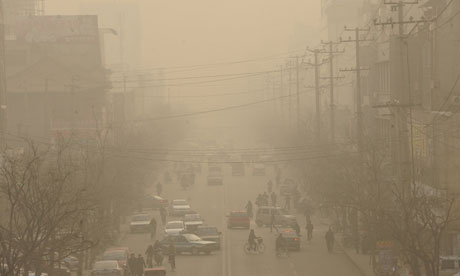
Smog down a main street of Linfen, in China's Shanxi province. 
Photograph: Peter Parks/AFP/Getty Images


Chinese authorities have set tougher rules to combat air pollution by ordering all major cities to monitor tiny particles that do serious damage to health. One of China's leading environmental activists, Ma Jun, greeted the change as a major step forward.

Surprisingly, given China's strict control of the internet, state media have acknowledged the change is partly in response to online environmental campaigners.

The national air quality rules were agreed at an executive meeting of the state council presided over by the premier, Wen Jiabao, on 1 March, a statement on its website said.

They order stricter air pollution monitoring standards this year in the mega-cities of Beijing, Shanghai, Chongqing and Tianjin, 27 provincial capitals, and three key industrial belts: the Yangtze and Pearl river deltas, and Beijing's hinterland. Another 113 cities must adopt new standards next year, and all but the smallest cities by 2015.

To "help allay public concern over official air quality readings", levels of ozone and PM2.5 particles must be included. PM2.5 particulate matter is below 2.5 micrometres in diameter, or 1/30th the width of an average human hair, and easily penetrates lung tissue.

"This is a major step forward in terms of China's process to combat urban air pollution," said Ma Jun, director of the Institute of Public and Environmental Affairs. "The prerequisite for mobilising our people is to let them know what is going on.

"It doesn't mean that the sky will turn blue automatically because at the end of the day we still need to cut off these emissions."

Following the announcement, more than a million – mostly positive – comments were posted on the Weibo micro-blogging service in under 24 hours. "Good news, applause," wrote Xu Xiaonian, a prominent economist. Others questioned whether the rules would be enforced.

In January, Beijing's environmental agency included PM2.5 particles in its calculations after months of postings from netizens mocking the discrepancy between officially clear days and the dense smog at their windows. Ma said social media had played an essential role in changing government policy last year.

State media also acknowledged the role of bloggers: "A stirring campaign on the country's social network websites since last autumn seemed to have gained a satisfying response from the country's policymakers," Xinhua news agency said.

-------------------------------------------------------


The heavy smog and haze that shrouded Beijing on the weekend — pushing the pollution index to a record high — has been dubbed the "Beijing Cough" by the city's expat community, becoming increasingly popular with local media and Chinese.

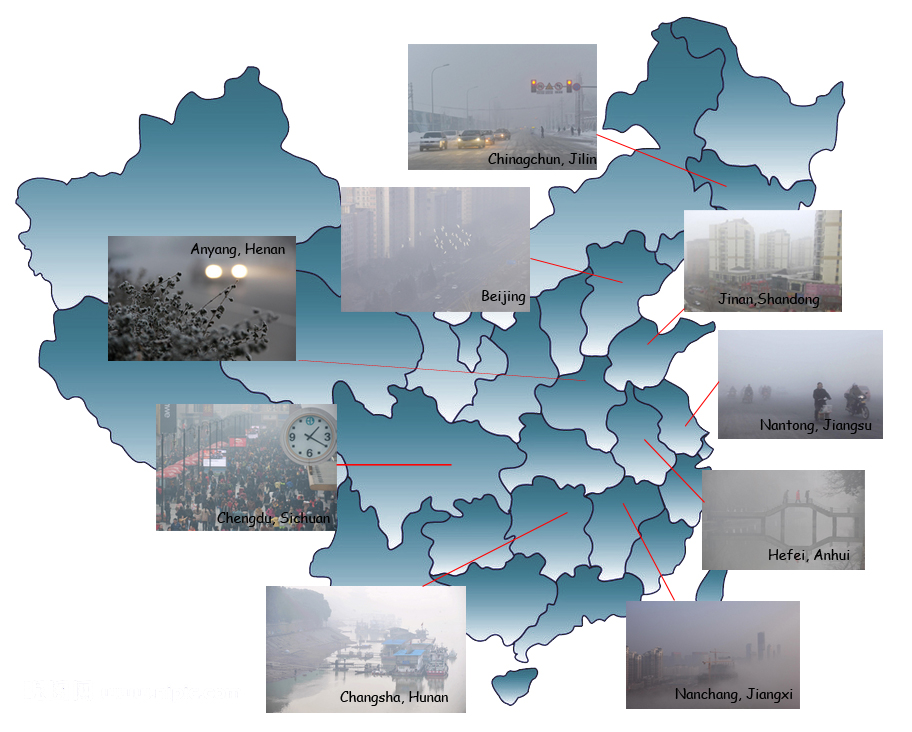
Meanwhile, many other cities also witnessed smoggy weather on the weekend. On Saturday, levels of PM2.5 passed 300 micrograms per cubic meter in 33 of the 74 cities with systems equipped to monitor the particles. Face mask sales surged and hospitals crowded with sick people in cities across the country.

Modern toxicology research has shown that exposure to PM2.5 can lead to significantly increased death rates due to cardiovascular, cerebrovascular and respiratory diseases, as well as increased cancer risk.

BEIJING - Beijing air pollution reaches dangerous levels.

not only in Beijung:


 http://www.chinadaily.com.cn/china/att/site1/20130115/f04da2db1484125f305819.pdf

Beijing's air pollution reached dangerous levels yet again on Sunday, marking the third consecutive day of severe smog, municipal environmental authorities said.
The municipal meteorological station issued the city's first orange fog warning Sunday morning due to decreased visibility caused by the heavy smog.
Monitoring data released on Sunday showed that air quality indexes in most regions of Beijing had hit 500, the indexes' highest level.
"Beijing implemented its emergency response plan for hazardous pollution for the first time on Sunday," said Yu Jianhua, director of the air quality department under the municipal environmental protection bureau.
The plan, issued last year, includes multiple measures to combat and respond to hazardous levels of air pollution.
The plan calls for construction sites to limit construction activity that creates large amounts of dust, as well as asks industrial enterprises to reduce emissions, during hazardous pollution days.
The plan also requires municipal traffic authorities to limit government vehicle usage during smoggy days, with the goal of reducing such usage by 30 percent compared to normal days.
The plan also calls for education authorities to instruct schools to limit or completely stop outdoor activity during periods of heavy air pollution.
The municipal environmental monitoring center said readings for PM2.5, or airborne particles measuring less than 2.5 micrometers in diameter, had reached more than 700 micrograms per square meter at several monitoring stations in Beijing, reaching as high as 993 Saturday evening.
"These figures represent extremely bad pollution. Pollutants have gradually accumulated over the course of recent windless days, making the air quality even worse," said Zhu Tong, a professor from the college of environmental sciences and engineering at Peking University.
The pollution is expected to engulf Beijing until Wednesday, when wind will arrive to blow the smog away, according to a weather report from the meteorological station.
Related stories:
China issues yellow fog alert
Dense fog shrouds Beijing
Smoggy weather engulfs large areas of China
China pledges $56 billion to cut air pollution
Experts explore Beijing's air pollution


Ref: http://www.guardian.co.uk/world/2012/mar/01/china-air-pollution-tough-rules
http://www.chinadaily.com.cn/china/2013-01/14/content_16115953.htm

Saturday, June 11, 2011

assurance and web 2.0 , e-insurance, Financial Services industry, and "social brain"


In 2008, global insurance premiums grew by 3.4%  to reach $4.3 trillion. The financial crisis (since sept. 2008; an highly improbable. event?) has shown that the insurance sector is sufficiently capitalised: the majority of insurance companies had enough capital to absorb this impact and only a very small number turned to government for support.
Modeling and analysis of financial markets and of risks are often based on the Gaussian distribution but 50 years ago, Benoît Mandelbrot discovered  that changes in prices do not follow this distribution: changes in prices are rather modeled better by Lévy alpha-stable distributions.

An increasing variety of outcomes are being identified to have heavy tail distributions, including income distributions, financial returns, insurance payouts, reference links on the web, etc... A particular subclass of heavy tail distributions are power-laws.
For example of a power-law, the scale of change (volatility), depends on the length of the time interval to a power a bit more than 1/2.

Power-law tail behavior and the summation scheme of Levy-stable distributions ( alpha- stable distribution) is the basis for their frequent use as models when fat tails above a Gaussian distribution are observed. However, recent studies suggest that financial asset returns exhibit tail exponents well above the Levy-stable regime (0 < alpha < = 2 ). A paper ( http://ideas.repec.org/p/wpa/wuwpem/0305003.htm) illustrates that widely used tail index estimates (log-log linear regression and Hill) can give exponents well above the asymptotic limit for alpha close to 2, resulting in overestimation of the tail exponent in finite samples. The reported value of the tail exponent alpha around 3 may very well indicate a Levy-stable distribution with alpha around 1.8.

One of the most important subclass of heavy tail distributions are power-laws, which means that the probability density function is a power. One of the most important properties of power-laws is its scale invariance. The universality of power laws (with a particular scaling exponent) has an origin in the dynamical processes (self-organized systems) that autogenerate the power-law relation. Risk is not only a tail distribution but also the consequences of "social brain" (i.e. Richardson's Law for the severity of violent social conflicts). 
For info on  "social brain", see the work of Robin I.M. Dunbar: 
http://ex-ample.blogspot.com/2011/06/robin-ian-macdonald-dunbar-cambridge.html


The terms long-range dependent, self-similar and heavy-tailed... cover a range of tools from different disciplines that may be used in the important science of determining the probability of rare events, which is the basis of insurance industry.

I think that e-insurance is not only online insurance. By  "integrating" of studies (econometrics, statistics, simulation on large corpus, social aspects...) and sharing of encrypted media (cloud computing; see: http://ex-ample.blogspot.com/2011/06/example-exemple-boxnet-html5-sharing.html),  insurance companies can leverage on Web 2.0 technology  to online evaluate financial informations and deliver insurance products to the people, and to the networks of social media platform who need protection against risks.

Rem: if statistics are too complex (as Churchill already said: "There are lies, damn lies - and statistics."), this problem is in fact simple. I try to explain this behavior with an example: if we consider the sizes of files transferred from a web-server, then the distribution is heavy-tailed, that is, there are a very large number of small files transferred but, crucially, the "small" number of very large files transferred remains a major component of the volume downloaded.